Tuesday, June 15, 2010

physics flashback

like many college graduates a few years removed from the excess, debauchery, and delusion that is the prototypical, modern american college experience, i often wonder whether/hope that my choice of major in school contributed something positive to my personal development.

my official record labels my undergraduate program of study as "engineering physics". without delving into uninteresting details, essentially, this was one of those interdisciplinary programs created for independent-minded (read: flailing) learners that do not really know what they want. practically, the choices i made in my program turned it into a physics degree with no lab experience, sprinkled with chemistry, electrical engineering, and computer science. for the present and near future the only aspect that has provided me with any commonly recognizable utility, as far as my career goes, is computer science.

recently, i cannot help but think that this is a shame. after all, i learned a lot of cool things about electromagnetism, optics, solid-state physics, and quantum mechanics. and for about a month or two after my last physics course, i actually remembered something. i once had grand delusions of being a theoretical physicist - of being able to look at a white board of equations and elicit within myself that fleeting awe that comes when one temporarily internalizes the beauty and symmetry of the pithy scaffolding that underlies existence.

but that path is not meant for me. the mathematical virtuosity that is required to perform in that venue eludes me. all i have now are bits and pieces that are recalled when i stumble across a complex idea in a physics article or signal processing paper.

but i do remember the feeling i had when i experienced one mesmerizing derivation during one of my last days in a physics course. it came from the rock star of a physicist dung-hai lee, who itamar and i had the fortune of taking our second semester of quantum mechanics with.


the author of the linked text does an admirable job of recapturing the awe i felt at the time. somehow, by starting with the most basic equation in quantum mechanics - one that communicates no information about electromagnetism - and applying a physically meaningless (allowable) transformation (known as a gauge transformation) using purely mathematical logic, one ends up implying the existence of electromagnetism! what?!

the universe is crazy beautiful, and i suppose having the opportunity to truly experience that weirdness on some personal level is something - even though it is also nothing.

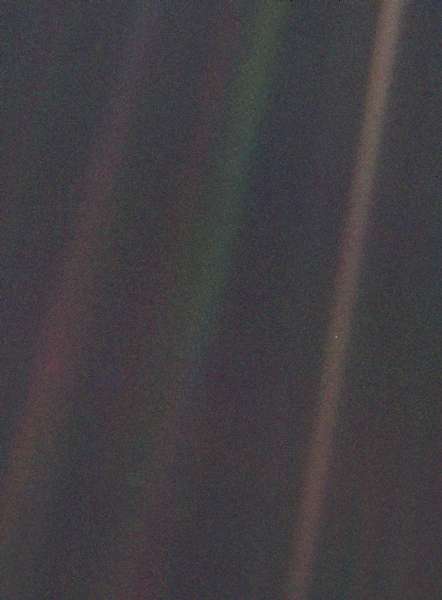
Sunday, June 6, 2010

pale blue dot


this picture of earth (its the bright white pixel) was taken by voyager 1 on february 14, 1990 at the suggestion of carl sagan as it was traveling through the outer reaches of our solar system and about to leave our neighborhood.

carl sagan later recorded his thoughts on the image and articulated, among others, these beautiful words...

consider again at that dot. that's here. that's home. that's us. on it everyone you love, everyone you know, everyone you ever heard of, every human being who ever was, lived out their lives.

the aggregate of our joy and suffering, thousands of confident religions, ideologies, and economic doctrines, every hunter and forager, every hero and coward, every creator and destroyer of civilization, every king and peasant, every young couple in love, every mother and father, hopeful child, inventor and explorer, every teacher of morals, every corrupt politician, every "superstar", every "supreme leader", every saint and sinner in the history of our species - lived there - on a mote of dust suspended in a sunbeam.

the earth is a very small stage in a vast cosmic arena. think of the endless cruelties visited by the inhabitants of one corner of this pixel on the scarcely distinguishable inhabitants of some other corner, how frequent their misunderstandings, how eager they are to kill one another, how fervent their hatreds. think of the rivers of blood spilled by all those generals and emperors so that, in glory and triumph, they could become the momentary masters of a fraction of a dot.

our posturings, our imagined self-importance, the delusion that we have some privileged position in the universe, are challenged by this point of pale light.

when i think about the glory of my insignificance, it makes me smile :- )

Saturday, May 15, 2010

vesuvan doppelganger

i still pat myself on the back about it to this day.

i once traded a friend a wall of brambles for a vesuvan doppelganger - yes, that's right - a fucking vesuvan doppelganger!!

but i digress...well actually, no i don't digress; i haven't even presented a cohesive thought yet so i can't possibly have digressed...phew! you see, i have this problem of getting sidetracked and veering off the main point when i talk - fortunately i don't have that problem when i write..............allow me to congress...

i grew up in a idyllic neighborhood surrounded by several boys all around my age. as i think back, i realize that we did not really have anything in common. this fact is probably why i haven't had a meaningful interaction with any of them since middle school. well that and they were all assholes.

that might be overstating the point, let us just say that every kid in the neighborhood grew up with the knowledge that in any social context involving more than two of us, anyone of us was liable to be viciously stabbed in the back if it meant that there was social capital to be gained from the act.

say what you will about julius caesar, at least brutus had the decency to actually stab him in the back. tragedy my ass - that troglodyte got out easy. also, we did have one thing in common, we all hated to lose to each other. baseball, basketball, madden, mario kart, capture the flag, hockey, pogs, baseball card collections, and my personal favorite - magic cards! although i used to consider these kids my friends, i have now had the fortune of real friends and i know the good, old neighborhood crew for what they were - amicable combatants (most of the time).

besides simply being an enormously fun game, magic cards in particular provides two distinct paths to demeaning and demoralizing one's friends. there is the classic beat down 1v1 stylie, involving the disarming and humiliation of one's opponent by objectively proving that every decision that they made in constructing their deck was a poor one; and then there is the cold-blooded trade, involving trading a friend a card of questionable value in return for pure gold.

even though you probably have no idea what it means because you actually had a life when you were in the fifth grade, allow me to present the vital stats of the trade involved.

vesuvan doppelganger
card type: creature
creature type: shapeshifter
power/toughness: */*
casting cost: 3UU
card text: upon summoning, doppelganger acquires all characteristics except color of any one creature in play on either side; any creature enchantments on the original creature are not copied. during controller's upkeep, doppelganger may take on the characteristics of a different creature in play instead. doppelganger may continue to copy a creature even after that creature leaves play, but if it switches it won't be able to switch back.

wall of brambles
card type: creature
creature type: plant wall
power/toughness: 2/3
casting cost: 2G
card text: G: regenerates.

so, to reestablish the situation - i had a wall of brambles and my "friend" had a vesuvan doppelganger. you do not understand anything about these vital stats that i just wrote - fine. but i think that you do notice something about these two cards even though you are a complete newbie - the description for a vesuvan doppelganger is complicated - the description for a wall of brambles is a bit simpler.

you see, i screwed my amicable combatant because i looked at the vesuvan doppelganger and realized that there was a good chance that he did not know what the card text meant (you most likely have no idea what the card text means either - but trust me, it is sweet). in magic, a complicated description often does not a valuable card make - and i screwed him - hard. the wall of brambles is a decent card - but most expert players would never waste a spot in a deck for one. a vesuvan doppelganger however, can be the basis of a kick-ass deck.

am i immoral for allowing my friend to make this trade with me?

Thursday, May 6, 2010

What Privacy?

Has it ever occurred to you that you don't know your friends as well as you think? Well, now the internet has the answer. A website called spokeo can now with a simple search fill you in on what you're missing. Here check me out. And by things that you might be missing I mean address, household, facebook pics, approximate credit score, home value, income, age etc. Ok, so that might not be the most valuable thing for improving friendships. But it might be really valuable for people who wanna sell me shit.

Meanwhile Facebook is pulling another one of it's patented "We've changed our privacy policies and you have no clue what's going on" moves. Frankly, I don't trust them and I'm not exactly sure why.

Am I being silly here? Is this all part of the natural and desirable spread of information? Or is the complete commodification of self and society? Who actually stands to gain from all of this?

Wednesday, April 21, 2010

the weird thing about computers

i love math. i love science (well at least science done by people who know math). i love statistics (well at least statistics done by people who know math). so i guess what im really trying to say is i love math.

but not even close to as much as i love engineering things and as much as i love designing things. but veej/vee/veejizzle, you might be asking yourself - isn't engineering basically a "math thing"? well yes it is - sort of - at least as much as say deciding what piece of furniture to buy at ikea is a "math thing".

the difference is that whereas the discipline of science is the art of correlating, extrapolating, and interpolating the world using and in relation to mathematical models, engineering/design is the art of constructing or assuming a set of obstructions and design restrictions - and then maximizing or minimizing various abstract variables to meet those restrictions as optimally as possible. the fact that it involves math is besides the point, as opposed to science. for example, let's take the engineering/design problem of producing energy without pollution - what might our set of obstructions include?
  • minimize CO2 emissions -> zero emissions
  • minimize emissions of "other" hazardous waste (problem with nuclear, batteries, electric cars)
  • maximize distribution
  • minimize centralization
  • minimize capital $$ costs
  • minimize $$ of energy production/maximize efficiency of whatever physical/chemical/biological process is involved
  • minimize use of rare-earth elements (huge problem with solar cells)
  • maximize energy produced per unit area of land
  • minimize noise pollution
  • minimize visual pollution
  • minimize impact on animal habitats/behavioral patterns (problem with wind farms, wave energy)
  • minimize dependance on space (i.e. sun shines/wind blows more intensely in some places than others)
  • minimize dependance on time (ditto for time of day)
  • minimize the concentration of these externalities in poor, rural socioeconomic areas
then of course, there is the process of critiquing the initial assumptions involved in framing the problem, however one chooses to frame it. in this case, the best critique of my statement of the design problem is: "who says that we have to keep consuming as much energy as we do in the first place?". i would respond that we know the theoretical limits of efficiency measures and that there is a strong, across-the-board correlation between cheap, reliable energy and quality of life. it would be a moral hazard to deny access to the same thing we enjoy to the 1/2 people in the world who don't over the next 50 years. assuming a just global society, energy use is going to go up - by a lot.

but that's besides the point, the point is to outline the general process that applies to any good engineering decision. but something interesting just happened. notice that every person would go through the process i just made differently in terms of ordering the list and accepting assumptions (even if we took people of the same moral bent). there is no equation that can resolve this conflict, that is because engineering/designing actual things (not just theorizing about the possibility of making them) is a personal, subjective process.

if the universe is turtles all the way down (which i think it is, in a sense), then a computer is subjective hacks all the way down. take this macbook pro im typing on right now. (that's right i've turned to the dark side...more on that another time perhaps.) steve jobs may be a ruthless totalitarian who should be ashamed to call himself a hippie, but he is the creator of one of the greatest industrial engineering processes ever to exist (apple). every decision (not all made by apple) from the layout of each etch in the thumbnail-sized piece of silicon that controls the probabilistic distribution of electron density to the fact that the little apple logo at the upper-left hand corner of my screen is 14 pixels from the left edge of the screen is a personal, subjective decision made by some engineer/designer at some point. this is a fact.

i love how people who have never done a lick of real engineering or design in their lives (read: EVERYONE - including most people who call themselves engineers), assume this is a cut and dried process. that somehow by knowing what the problem is, means that the solution is easy.

wrong. it is in designing the solution where all of the positive and negative actually happens. and this is the case whether one is examining a set of constraints being handed to an engineer or a policy that is passed by the legislative branch and handed to the executive branch.

Sunday, April 18, 2010

What's that smell?

So I've thought about my meat consumption for a long time. That may or may not have to do with driving past Harris Ranch along the I5 many times a year throughout college. And it may or may not have to do with the fact that I only seem to date vegetarians.

Regardless, at this point it's clear to me (and seemingly to everyone who's thought about it) that the way we get most of our meat is radically unstustainable, unethical, and unhealthy. Huge amounts of cattle are crammed into tiny tiny lots, pumped full of antibiotics to help them grow to unnatural sizes, and shipped enormous distances to industrial slaughterhouses, leaving enough waste to be rival transport as the biggest contributor to global climate change. Americans eat this cheap meat three times a day and then worry about the "obesity epidemic." There's simply no question that this system must change.

How does a libertarian even begin to answer this problem? Consumer choice? Yeah right. If it were only about people getting fat, then maybe, just maybe, you could say leave it to the consumer, the individual is the only one who can know what's best for them. But we've got people getting fat, diseases evolving immunity to antibiotics, skyrocketing health-care costs, and an incredible amount of waste and green-house gas emissions contributing to potentially devastating climate change. The current trend in conscious consumerism is wonderful and hopefully it will mobilize a thriving economy of sustainable, ethical food production. But it will not transform the system.

At the end of the day you just need governance to limit the power of the profit motive. Even from a purely capitalist theoretical standpoint you have to be able to give consumers equal access to information. But beyond that you have to stop corporations from selling us destruction, or at least you have to force us to pay the full price.

Wednesday, March 31, 2010

talk me left...lord please, talk me left

more than once in the last couple of weeks i have, "lo and behold", found myself calling myself a libertarian. i just finished watching an interview with this guy named thomas sowell and find myself agreeing with everything that he says (watch it and you'll see why this troubles me). the interviewer is kind of annoying, but sowell is amazing.

i'll just review some of the more interesting aspects of his wikipedia personal history. wikipedia is supposed to be open content so i assume that plagarism isn't an issue here :-).

thomas sewell was born in 1930 in north carolina and his father died before he was born. he moved with his mother's sister to harlem and attended stuyvesant high school, but had to drop out at age 17. he worked in a machine shop and as a delivery man until he was drafted to the marines during the korean war in 1951.

after he was discharged he got his ged and enrolled in howard university (a historically black school) to later transfer to harvard university where he graduated magna cum laude in economics. yada, yada, yada, he graduates from columbia and the university of chicago. now for the last 30 years he has been a senior fellow at the hoover institution at stanford university, a conservative, libertarian-leaning think tank.

oh, and he's black. yeah, that matters to me.

aaanywho, clearly i say all this because i'm enamored with the guy and he happens to be right in line with what i'm feeling at the moment - but...

let's forget for a second that his arguments/examples are brilliantly constructed and presented with wit and personality. based on his life experiences, knowledge, and intellect alone - what possible basis do i have to not take him at his word?

Wednesday, March 24, 2010

New Architectures

Vijay, part of the fight is learning acceptance, learning submission. I suppose that doesn't feel like fighting and maybe it's not. But it is right and true and beautiful even.

We are used to fighting, and maybe living, meaning just one thing (one thing at a time perhaps), and when suddenly we hit a new mode we are startled. But that is how true change happens, personal and social.

We work real hard on trying to improve and accelerate what already exists and then we are blindsided by the new.

Tuesday, March 16, 2010

hanging on for dear life

maybe this is just my tendency to drift through life without giving too much of a shit about anything / inevitable shedding of my youthful idealism / my enviable position in this glorious mess talking, but lately i have been losing the willingness to fight my own impulses much less anything external to myself.

i find the anger that i used to feel when i would read about the latest stupid thing some national government did or the inane opinions of some random person on fox news fading. but it's a different kind of apathy than what i used to feel in college. in fact, i'm not sure i would call it apathy because apathy always carries with it hints of depression for me and i feel more invigorated by the sensation than anything.

the more i think about it, i can't honestly say that i've ever felt in control of anything. and i don't say that with dismay, just a matter of fact.

i don't know if what capitalism is doing to our world is a good thing and i don't plan on finding out in my lifetime. but my friend mel once said "if you aren't nervous and in over your head, you're doing something wrong." well, i'm sure as hell nervous and we are definitely in over our heads, but i'm not sure "another way" exists (easy for me to say).

right now i'm just trying to keep my eyes and ears open and hang on for dear life.

Monday, March 15, 2010

Pick a Bigger Weapon

Perhaps this is the biggest problem with capitalism:

Consumers are wildly outgunned.

All the moneyed interests in the world are vested in our increased consumption. There is no power save our own will that weighs in against buying. The only competition is between which thing to buy and never between buying or not buying. We don't stand a chance.

It's this "competition" that gives capitalism it's very real power to arrange and rearrange wealth in a way that creates more wealth, but also in a way that over-exploits resources, ignores human dignity, and diminishes any hope for human equality.

Protests and conscious consumerism are nice but seriously, we need to pick a bigger weapon.